
HYPERVIGILANCE
HOLDING EVERYTHING AND EVERYONE TOGETHER
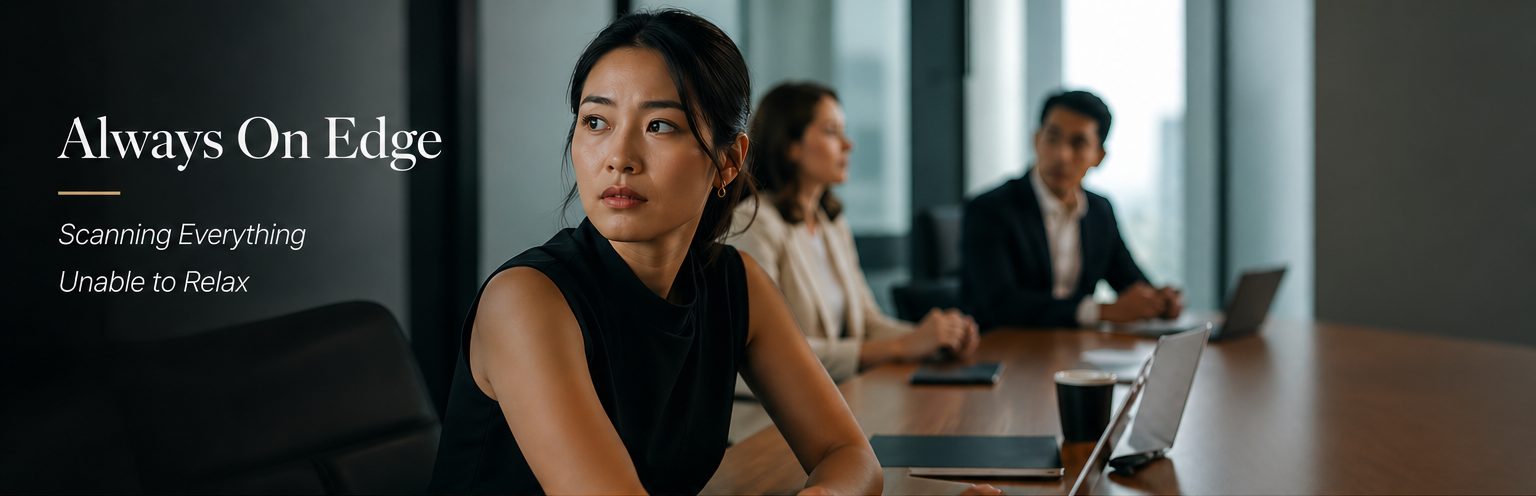
Women feel the need to hold everything together, all the time, and for everyone. This includes our households, friends, co-workers, and so on. This leads to what I call, inappropriate responsibility, and results in an over-active nervous system. Leaving you feeling exhausted, overwhelmed, fatigued, and nervous without an ability to shut off or relax.
THE PATTERN - NEEDING TO READ EVERYTHING
You only sometimes refer to it as anxiety, and feel the constant need to scan the room, other’s reactions, and their words. This creates tension in your body, and the feeling that you can’t fully relax - even when nothing is truly wrong.
You’re paying attention:
- To tone
- To shifts in the room
- To what someone might mean
- To what could go wrong
You anticipate what might come next so that you’re prepared, before anything happens or anything is asked. You stay alert enough so that nothing catches you off guard. And most of the time it looks like:
- Competence
- Awareness
- Attention to detail
- Being “on top of things”
But underneath it, your system remains in overdrive and never gets a break. You don't feel like taking a rest is possible, or your down time involves doom scrolling since you can't sit with your own, quiet thoughts.
WHAT IT ACTUALLY FEELS LIKE
You might not know that this is called hypervigilance:
- You can’t fully relax, even when you try
- Your body feels tense for no clear reason
- You’re always aware of what’s happening around you
- You anticipate problems before they exist
- You feel responsible for catching what others miss
- You feel responsible for others feelings, choices, actions, lack of actions, performance, etc.
- You struggle to not think about work or your other responsibilities at the end of the day
This might feel like you are out-of-control and cause you to attempt to gain more control. This leads to overwhelm, agitation, and more.
WHY HIGH-PERFORMING WOMEN BECOME HYPERVIGILANT AND WHY IT DOESN'T JUST STOP
Most women I work with:
- are highly perceptive
- have strong relational awareness
- operate at a high level professionally
But their nervous system learned early: Pay attention and stay alert to stay safe
So now, instead of simply participating, you’re:
- monitoring reactions
- anticipating outcomes
- preventing conflict before it happens
All this while trying to perform at a high level. It is more than overthinking, and it is actually not a part of high performance. It’s conditioning that has wisely adapted. It became faster. Sharper. More predictive. More prepared.
But it didn’t learn when to stop.
From a neuroscience perspective, this is chronic activation of your threat detection system. This is often associated with prolonged exposure to stress, pressure, unpredictability, or environments where missing something had a cost.
So now, even in calm moments, your system keeps scanning.
Not because something is wrong. Because it learned to assume things are not okay.
WHERE HYPERVIGILANCE SHOWS UP
This pattern is a part of and goes beyond general anxiety.
It often looks like:
- Being the one who “catches everything” in meetings
- Anticipating objections before they’re raised
- Preparing for conversations that haven’t happened
- Reading subtle shifts in tone or behavior
- Overanalyzing interactions after the fact
- Feeling responsible for maintaining stability
- Not coping when you receive neutral or mild to moderate feedback or criticism
- Over-managing things at home, feeling like you’re the only one who can accomplish said things
You’re not falling apart; although, it might feel that way at times. You’re holding everything together. At a cost.
JOIN ASSERTIVE WOMAN
FINDING A NEW WAY
You can learn the skills needed to find a new way of existing within your common spaces. And you can do this without abandoning yourself, your values, or the things that make you - you. This requires capitalizing on your motivation and intentionally examining underlying patterns, as well as, executing new boundaries, communication skills, and improved interpersonal interactions. This is worth doing, as it spans workplace culture, leadership opportunities, and private life.
HOW TO STOP FEELING CONSTANTLY STRESSED AND ON EDGE ALL THE TIME - WHEN NOTHING IS ACTUALLY WRONG
Most advice gets this wrong; telling you to:
- Relax
- Stop overthinking
- Be present
- “Just calm down”
That doesn’t work, because this isn’t a thinking problem. It’s a patterned response, that needs appropriate intervention to help you find balance, rest, and the opportunity to let go. Many reading this likely respond to that last line with a thought like:
“I can’t possibly do that! Nothing will get done at best, and everything will fall apart at worst.”
and/or
“XYZ harm will come to me or others if I do this.”
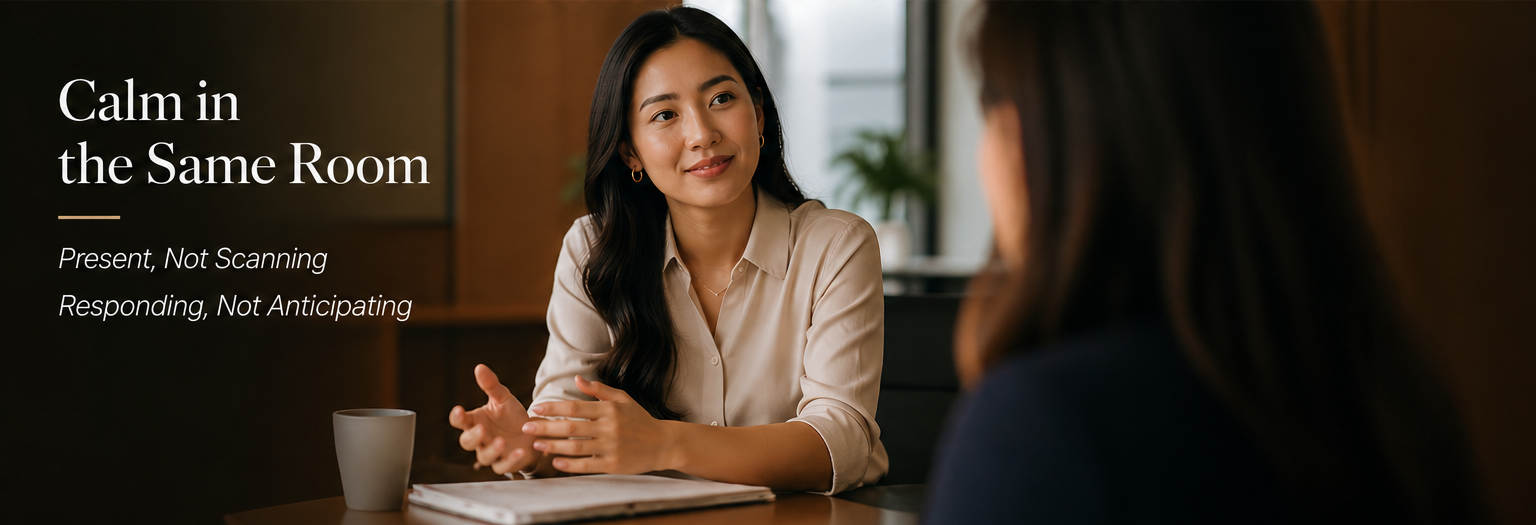
Improved regulation that gives you energy and clarity of thought is not the same thing as irresponsibly dropping everything. We are talking about moving away from hypervigilance. Shifting away from unproductive, energy zapping, anxious states.
Real change happens when you:
- Recognize when your system shifts into scanning mode
- Interrupt the automatic escalation
- Create a different internal response before it compounds
This requires next-level skills that we cover here at Assertive Woman. Don’t worry, we’ve got you!
WHAT MOST PEOPLE MISS ABOUT CHRONIC STRESS CAUSED BY HYPERVIGILANCE
Hypervigilance is exhausting and misleading, because it convinces you that:
- Your awareness is always accurate
- Your anticipation is necessary
- Your tension is protective
But over time it distorts perception. You start reacting to what might happen, instead of what is happening. This creates:
- Mental fatigue
- Emotional drain
- Reduced clarity
- Strained communication
Even when everything externally looks “fine” or even like you are at peak performance, but you can’t relax even after you succeed or have a big win. You can’t stop thinking about work problems, and you prepare for the worst case scenario even when you are doing well.
WHAT CHANGES THE PATTERN OF CONSTANTLY FEELING ON EDGE AND HYPERVIGILANT
This doesn’t change through willpower or awareness alone. It changes when your system experiences:
- Safety without constant monitoring
- Pause without consequence
- Presence without needing to prepare
Which requires a different approach than most people have been given. We teach you how to do this.
THE OPPORTUNITY TO SHIFT
Instead of the thoughts you experienced above, that you could not possibly let go safely, I invite you to consider engaging with us. Not to pile onto your already full plate, but to learn how to use your existing resources to reduce the burden through skill building, pattern recognition, internal regulation, healthy boundaries, appropriate responsibility, and more - without abandoning yourself in the process.
You don’t need to become less aware. You need to become less activated. So your awareness becomes a choice, not a constant state.
ASSERTIVE WOMAN
If you recognize this pattern, you’re not alone. You’re also not stuck. There is a way to retrain how your system responds without losing the strengths that made you successful. This boosts your personal growth, improves leadership potential, and influences home and workplace culture.
