
HEALTHY ASSERTIVENESS
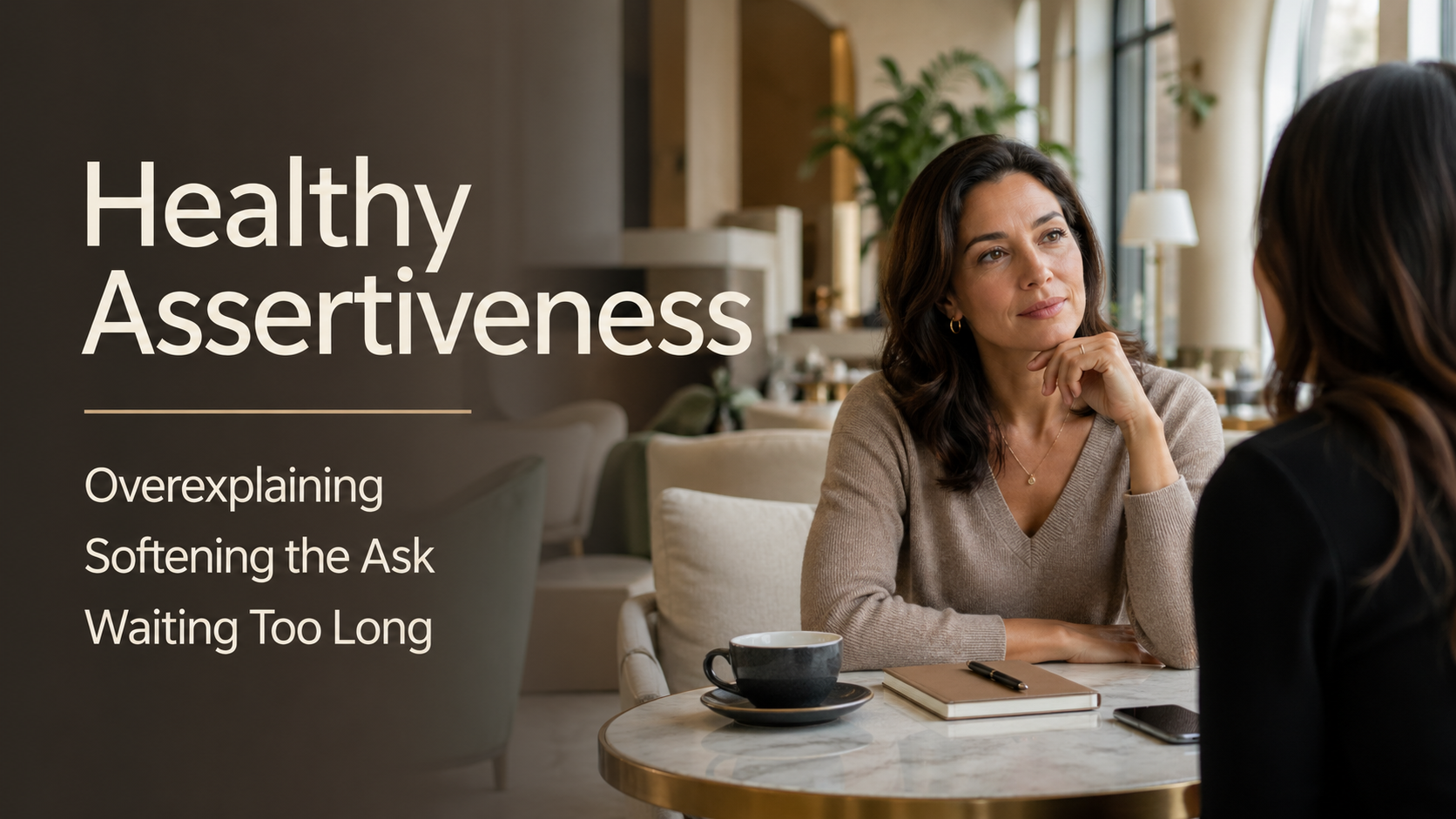
WHEN “NICE” BECOMES SELF-ABANDONMENT
Many high-performing women know how to communicate well, but still find themselves over-explaining, apologizing, softening their opinions, or avoiding conflict to keep the peace. Over time, this can show up as resentment, burnout, people-pleasing, workplace stress, communication anxiety, or feeling invisible in rooms where your voice should carry weight.
Sharpening your communication skills contributes to your personal growth and professionalism. However, those skills will not help you, if you struggle to speak up and repeatedly hold back. Communication skills require engagement.
YOU DO NOT HAVE TO CHOOSE BETWEEN BEING LIKED AND BEING CLEAR
Healthy assertiveness is not being harsh, cold, demanding, aggressive, or “too much.” It is the skill of staying connected to yourself while communicating clearly with other people.
For many of the high-performing women that I work with, the problem is not just that they lack confidence. The nervous system learned to treat directness as danger, so they soften the ask, over-explain the boundary, apologize before the sentence is finished, or wait until resentment builds and the words come out sharper than intended.
This program is for the woman who wants to speak up at work, ask for what she needs at home, hold boundaries in relationships, present with more confidence, and communicate without shrinking, overcorrecting, or abandoning herself.
HEALTHY ASSERTIVENESS IS NOT AGGRESSION
Most people are taught assertiveness as a communication skill.
- Use “I” statements
- Make eye contact
- Say what you need
- Be direct
That advice is not wrong. It is just incomplete. If your body has learned that speaking clearly might lead to conflict, rejection, criticism, being misunderstood, or being labeled as difficult, then assertiveness will not feel like a simple script. It will feel like a threat response.
That is why healthy assertiveness starts before the words. It begins in the pause where you usually edit yourself. The moment you feel the urge to say “sorry” when you are not sorry. The second you decide whether to name what you want or make it easier for everyone else.
Assertive communication means expressing your thoughts, feelings, needs, and boundaries clearly while still respecting the other person. It is different from passivity, causing you to disappear, or aggression, where you overpower.
Healthy assertiveness is the middle path:
- Clear without cruelty
- Direct without domination
- Warm without self-erasure
Comprehensive and secure migration to cloud environments, carefully designed to optimize performance, reduce costs, ensure seamless transition of all workloads, enhance operational efficiency, provide robust security and compliance, and deliver ongoing cloud management and support for long-term scalability and business growth.
THE PATTERN USUALLY SHOWS UP EVERYWHERE
If you struggle with assertiveness, it probably does not stay neatly in one category. It may show up at work when you have a better idea, but wait for someone else to say it first.
It may show up in meetings when you rush through your point, soften your tone, or add disclaimers so no one thinks you are being difficult.
It may show up in public speaking or presentations when you know the material, but your body acts like visibility is unsafe.
It may show up with a spouse, partner, or friend when you say “it’s fine” even though it is not fine.
It may show up in parenting when you feel guilty setting limits, then exhausted when no one respects them.
It may show up in leadership when you know the decision that needs to be made but feel pressure to make your clarity more comfortable for everyone else.
This is why healthy assertiveness is not just about communication. It is about self-trust. Many people search for “how to be more assertive,” “how to speak up for myself,” “how to set boundaries without guilt,” “how to stop being passive,” “how to be confident at work,” or “how to be assertive without being aggressive.” The real question underneath many of those searches is:
How do I stay myself when someone else might not like it?
YOU CAN BE CLEAR AND STILL BE KIND
The goal is not to become louder, but to become less divided. When you are not practiced in healthy assertiveness, you often end up in one of two places:
You stay quiet to keep the peace.
Or you finally speak after holding it in for too long.
Neither is the same as power.
Healthy assertiveness helps you recognize the difference between a real threat and the discomfort of being visible. It helps you say what you mean before resentment turns the volume up for you. It helps you hold a boundary without turning it into a courtroom argument.
- At work, healthy assertiveness might mean naming a concern before the decision is already made.
- At home, it might mean expressing what is not working before you reach the point of shutdown or resentment.
- In parenting, it might mean holding a limit without over-explaining, apologizing, or giving your child’s disappointment more authority than your own judgment.
Assertiveness training often focuses on direct language, boundaries, tone, and “I” statements. Those tools can be useful, especially when paired with emotional regulation and self-awareness. But the deeper work is learning to tolerate the moment after you speak clearly. This is where the old pattern usually tries to pull you back.

JOIN ASSERTIVE WOMAN
CLEAR, CALM, AND HARDER TO DISMISS
Healthy assertiveness helps you build confidence without losing warmth. It teaches your nervous system that direct communication, clear boundaries, public speaking, leadership presence, and difficult conversations do not have to feel threatening. You can learn to speak with calm authority, advocate for yourself, and stay grounded without shrinking, performing, or pushing harder than you need to.
THIS IS NOT ABOUT BECOMING A DIFFERENT KIND OF WOMAN
You do not need a louder personality.
You do not need to become intimidating.
You do not need to copy someone else’s leadership style.
You do not need to perform confidence in a way that feels false.
Healthy assertiveness is not about becoming less caring. It is about no longer using your care for others as a reason to abandon yourself.
This matters especially for women in leadership, because assertiveness can carry a double bind. Women are often expected to be warm, collaborative, agreeable, and highly competent, while also being decisive, confident, and influential. That makes “just speak up” overly simplistic advice. Leadership communication for women often requires both clarity and strategic relational intelligence.
The work is not to ignore that reality.
The work is to stop letting it own your voice.
A BETTER WAY TO PRACTICE ASSERTIVENESS
Healthy assertiveness is built through small, repeated moments of self-respect. Not by waiting until you feel perfectly confident. Not by memorizing one perfect sentence. Not by becoming so calm that nothing bothers you.
You practice by noticing the moment you start to shrink. You pause before the automatic apology. You choose one clean sentence instead of five over-explained ones. You let yourself be warm without becoming vague. You let yourself be direct without becoming defensive.
Over time, your nervous system learns something new:
- Clarity is survivable
- Disagreement is survivable
- Being seen is survivable
Someone else’s discomfort does not automatically mean you did something wrong. That is the shift. Healthy assertiveness is not a performance. It is a pattern your body can learn.
FOR THE WOMAN WHO IS DONE TRANSLATING HERSELF DOWN
You may be here because you want to be more confident at work.
Or because you are tired of over-explaining your boundaries.
Or because you want to stop apologizing when you have not done anything wrong.
Or because you want to speak up in meetings, presentations, relationships, parenting, leadership, and everyday life without feeling like you have to brace for impact.
You are not looking to become aggressive; you are looking to become honest. And that is a very different thing.
ASSERTIVE WOMAN
Healthy assertiveness is the practice of saying what is true without leaving yourself behind. We work with you through courses, workshops, and one on one consultation to empower you in identifying improved ways to be your authentic self - out loud.
