
CREDIBILITY

ENGAGE IN A COMPLETE APPROACH THAT GOES BEYOND ASSERTIVENESS TRAINING
Assertive Woman brings together confidence, communication skill, nervous system awareness, and real-world experience with human behavior under pressure.
Our coureses are assertiveness training for women who are tired of shrinking, overexplaining, over-apologizing, or managing everyone else’s comfort at the expense of their own clarity.
Whether it shows up in your relationships, career, leadership role, or inside an organization, the work is not simply about “speaking up more.” It is about understanding what happens in the moment, building the communication skill to respond differently, and developing the steadiness to use that skill when the stakes feel high.
MOST ASSERTIVENESS ADVICE STARTS IN THE WRONG PLACE
Most advice about how to be more assertive starts with what to say.
Use this phrase.
Hold eye contact.
Stop apologizing.
Speak with confidence.
Set a boundary.
Sounds simple until your body disagrees, because when you need to speak up, it is rarely neutral. It may happen in a meeting, during a hard conversation with your partner, while parenting, during a presentation, while managing a team, or while sitting across from someone whose approval, reaction, or authority matters to you.
You may know exactly what you think and still hesitate. You may have the words and still soften them. You may intend to be direct, but add a disclaimer, a laugh, an apology, or a quick escape route at the end.
And then comes the replay.
Did that sound too harsh?
Did I say too much?
Did their face change?
Should I have phrased it differently?
Was I clear, or did I make it weird?
This is where confidence advice alone falls short. The real work is learning how to communicate clearly while your system is calculating risk.
OUR APPROACH IS DIFFERENT
This work is grounded in more than theory. It comes from my two decades of experience working with people in the moments where emotion, pressure, communication, identity, trauma, conflict, and power all collide.
This includes the private moments when someone cannot say what they need in a relationship. The professional moments when a capable woman edits herself in a meeting because she does not want to be labeled difficult. The leadership moment when an executive has to navigate visibility, authority, conflict, and expectation without abandoning herself in the process. The organizational moment when communication norms, culture, and leadership behavior determine whether people speak honestly or stay quiet.
The same patterns show up everywhere.
At home.
At work.
In leadership.
In boardrooms.
In teams.
In relationships.
In the body.
The setting changes, but the core issue often does not. People learn how to protect themselves. They learn when to soften, when to scan, when to wait, when to overexplain, and when to disappear from their own message.
Assertive Woman helps women and organizations work with those responses directly, so clarity becomes more available when it matters.
Assertiveness is not one thing. It is shaped by:
- Confidence
- Communication skills
- General past experiences
- Nervous system responses
- Relationship dynamics
- Workplace culture
- And the times speaking clearly once came with a cost
That is why generic advice does not work for many high-performing women. You can know what you want to say and still hesitate. You may be looking for ways to build capability and gain respect, and the need to answer “How do I actually do that?” holds you back from accomplishing your goals.
Sometimes the issue is confidence. Sometimes it is skill. Sometimes it is a conditioned response that takes over before you have time to think. And often, it is all three working together.
Assertive Woman is built on human behavior under pressure, communication breakdowns, trauma patterns, leadership dynamics, and the real-life moments where confidence, boundaries, and influence matter most.
WHY TRUST MATTERS IN THIS WORK
This work asks people to look closely at patterns they may have used for years to stay safe, accepted, respected, or connected.
That requires trust.
It requires more than motivational language.
It requires experience with the complexity of human behavior: how people protect themselves, how communication breaks down, how pressure changes behavior, how past experiences shape present reactions, and how real change happens without shame.
Assertive Woman is designed for women who do not need to be talked down to, hyped up, or told to become someone else.
They need a serious, practical, deeply human approach to becoming more direct, more grounded, and more effective where it actually matters.
JOIN ASSERTIVE WOMAN
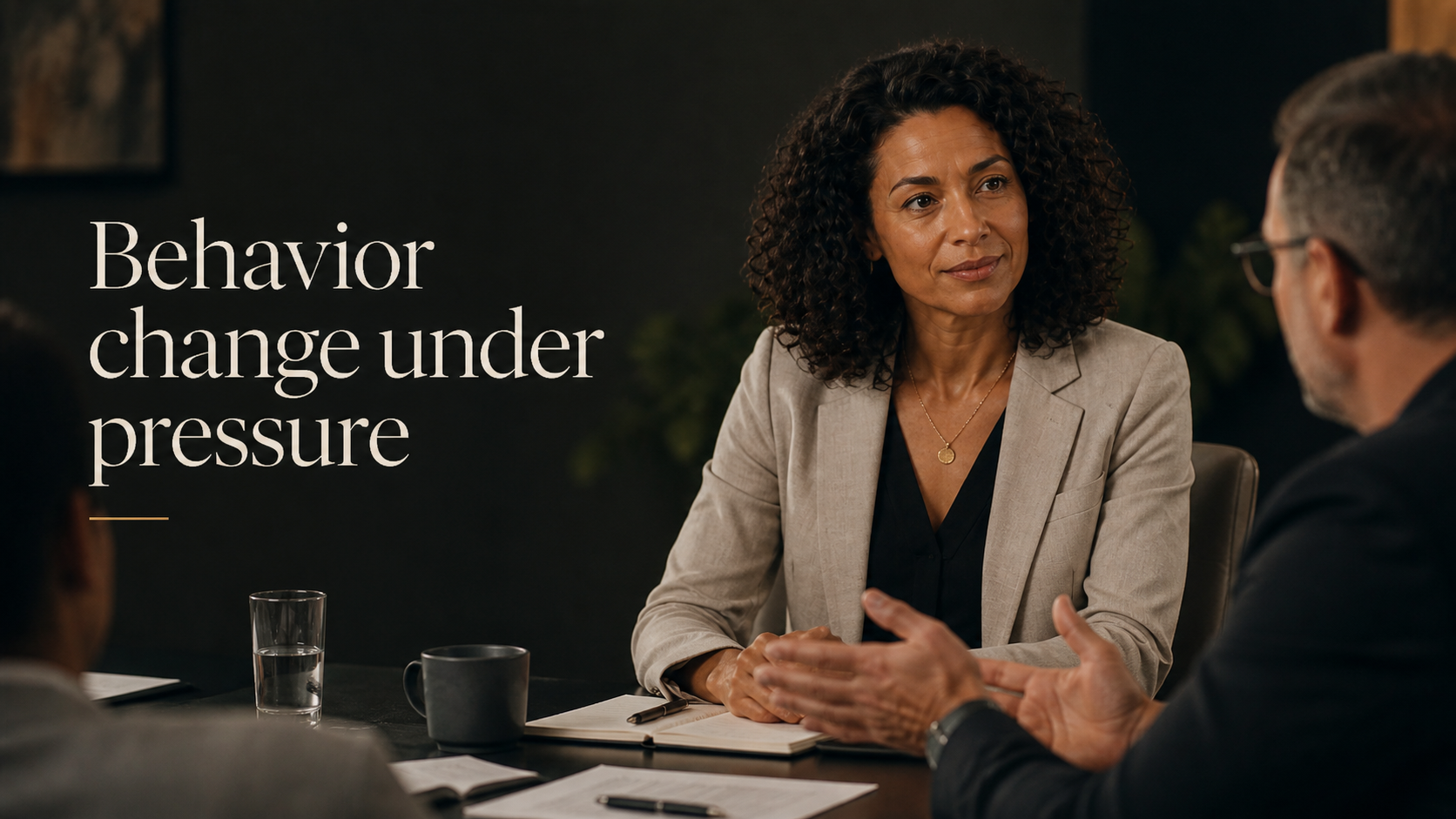
TWO DECADES OF HUMAN BEHAVIOR UNDER PRESSURE
The solution is not to memorize a few assertive phrases and hope they appear when pressure rises.
Real change requires learning what happens in your body, your language, your thoughts, and your behavior in the exact moment you are tempted to disappear, soften, defer, over-explain, people-please, or react.
Assertive Woman brings together nervous system awareness, communication repair, practical skill-building, leadership insight, and behavioral practice so the change is not just intellectual. It becomes usable when it counts.
PERSONAL: WHEN SPEAKING UP FEELS COMPLICATED
For many women, assertiveness is not simply about being more direct. It is about the history underneath the hesitation.
Maybe you learned to keep the peace. Maybe you became the responsible one. Maybe you became highly attuned to other people’s moods, disappointment, criticism, silence, or withdrawal. Maybe you were rewarded for being agreeable, easy, flexible, low-maintenance, or “not a problem.”
Those patterns can look functional for a long time, until you realize they are costing you. They show up when you say “yes” too quickly. When you explain too much. When you feel guilty for having a preference. When you absorb tension that does not belong to you. When you resent people for not noticing what you never actually said.
Personal assertiveness work is not about becoming forceful, selfish, or hard to be around. It is about learning how to stay connected to yourself while communicating clearly with someone else.
PROFESSIONAL: WHEN COMPETENCE STILL IS NOT ENOUGH
High-performing women are often told to be confident, speak up, negotiate better, use their voice, take up space, and stop second-guessing themselves.
But that advice skips the harder question:
What happens inside you in the moment before you speak or after you’ve participated?
For many women, there is an invisible calculation happening below the surface:
Will this sound too aggressive?
Will they think I am difficult?
Will I damage the relationship?
Will I be seen as emotional?
Will this cost me the opportunity?
Should I soften it first?
That is why professional assertiveness training has to go deeper than scripts.
The goal is not to memorize a better sentence. The goal is to build the confidence, communication skill, and internal steadiness to say what needs to be said when the moment actually arrives.
This work supports women navigating workplace confidence, leadership communication, public speaking, difficult conversations, boundaries at work, negotiation, visibility, and the pressure to be both impressive and endlessly accommodating.
CORPORATE TRAINING: WHEN INTERPERSONAL TRANSACTIONS BECOMES A CULTURE ISSUE
Inside organizations, assertiveness is a personal development topic and a human capital issue.
When people do not feel safe enough, skilled enough, or supported enough to communicate clearly, organizations pay for it in ways that are easy to miss at first.
- Meetings become performative
- Feedback gets delayed
- Conflict goes underground
- High-performing employees burn out
- Women self-edit
- Leaders miss information they needed earlier
- Teams mistake politeness for alignment
Both overly polite company cultures and overly aggressive business cultures stifle productivity. Organizations get less from the tangible skills and intangible assets of their staff and managers, significantly impacting human capital.
This human capital risk may look like:
- Hesitation and an inability to work independently
- Managers and directors who cannot appropriately engage with their teams
- High talent turnover
- Conflict escalations
- Skilled staff disengaging and quietly deciding it is no longer worth the effort
- Drained executive bandwidth
- Weakened accountability
Unresolved culture issues turn into performance, retention, and leadership credibility problems. Significantly increasing risk.
When workplace culture does not support healthy assertiveness, emotional regulation, and direct communication, employee needs often surface indirectly. Concerns may show up as repeated complaints, reassurance-seeking, conflict avoidance, emotional escalation, or dependence on leadership to resolve tension. What looks like “neediness” is often a workplace communication issue: people do not feel equipped, supported, or psychologically safe enough to name needs clearly, tolerate discomfort, and participate in solutions. Strong organizational culture builds professional maturity by helping employees regulate under pressure, raise concerns constructively, navigate difficult conversations, and stay engaged in problem-solving.
Corporate assertiveness training, women’s leadership development, executive communication work, and human capital consulting should not be reduced to presentation tips or confidence slogans.
The deeper work is helping people communicate more clearly under pressure, while helping leaders build environments where direct communication does not require self-protection.
WHY GENERIC CONFIDENCE ADVICE FALLS SHORT
Generic confidence advice usually focuses on performance.
Stand taller.
Speak louder.
Use stronger words.
Stop caring what people think.
Many women are not struggling because they lack ambition, intelligence, or capability. They may be struggling because directness has been linked to risk.
Risk of rejection.
Risk of conflict.
Risk of being misunderstood.
Risk of being punished socially, professionally, or relationally.
Risk of being seen as too much.
And sometimes the issue is more practical: they were never taught how to communicate clearly in high-pressure moments without overcorrecting into harshness, defensiveness, or over-explanation.
That is why this work addresses more than language. Our programs are based on my speciality as a human interaction, trauma recovery, and systems expert with over two decades of my work as a psychotherapist and my leadership experience as a certified corporate director.
We look at confidence.
We build communication skills.
We work with human behavior under pressure.
Because real assertiveness does not begin with a sentence.
It begins with the ability to stay present enough to choose one,
Build Flexible Ecosystem
Design and build flexible, scalable digital ecosystems that adapt effortlessly to your evolving business needs, support seamless integration across platforms, enhance operational efficiency, and provide the agility required to grow, innovate, and stay ahead in a dynamic market.
A MORE INTEGRATED APPROACH TO ASSERTIVENESS
Assertive Woman's courses, trainings, and consultations are built for mothers, wives, female executives, woman leaders, and beyond who want practical change without flattening the complexity of why these patterns exist. The approach brings together:
CONFIDENCE DEVELOPMENT
Not performative confidence. Not pretending you are unaffected. Real confidence that comes from self-trust, clarity, and the ability to remain connected to yourself in moments that used to make you shrink.
COMMUNICATION SKILL
Learning how to be clear without overexplaining, apologizing, performing, disappearing, or becoming unnecessarily forceful.
BEHAVIOR PATTERN RECOGNITION
Identifying the automatic responses that show up across relationships, work, leadership, parenting, public speaking, and difficult conversations.
NERVOUS SYSTEM AWARENESS
Understanding what happens in your body when speaking up feels unsafe, exposed, risky, or costly.
LEADERSHIP PRESENCE
Building the ability to communicate with clarity, steadiness, authority, and influence without abandoning your values or your voice.
HUMAN CAPITAL INSIGHT
Understanding how individual communication patterns scale into team culture, leadership dynamics, psychological safety, retention, burnout, and organizational risk.
We don’t want you to become someone else. It is about removing the interference that keeps interrupting who you already are.
FOR WOMEN AND LEADERS WHO ARE READY TO STOP WORKING AROUND IT
You do not have to keep building a life around the moments you avoid.
The meeting where you stay quiet.
The conversation where you soften the truth.
The relationship where you absorb the discomfort.
The leadership moment where you choose the safer version of yourself.
The opportunity where you wait until you feel more ready.
The evenings where you analyze the day, play by play.
There is a different way to work with this.
Not by forcing confidence.
Not by becoming aggressive.
Not by pretending the hesitation is not there.
ASSERTIVE WOMAN
We can teach you how.
