
SHRINKING
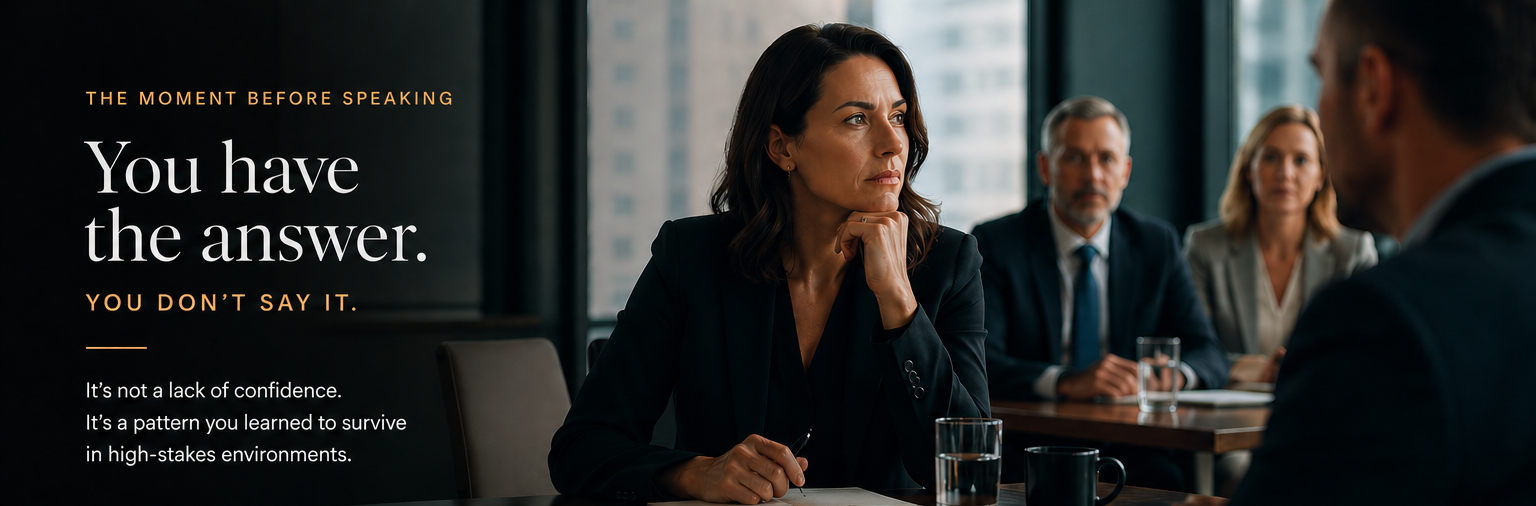
THE NEED TO MAKE YOURSELF SMALLER
Women have been conditioned to make themselves smaller - to hesitate on any statement, decision, or action that takes up space. This behavioral pattern affects women not only at work, but at home, while parenting, setting household priorities, or engaging with their spouse.
This hugely affects the way women show up and engage in the workplace. There is societal pressure to remain relational and nurturing despite the professional setting. This creates a near impossible scenario for women, who are required to be just as skilled as their male counterparts. Or must out-perform them for the same recognition plus remain warm, caring, and supportive.
WHY HIGH-PERFORMING WOMEN HOLD BACK
Most women I work with are already motivated, performing well, and operating at a high level. Often, they are moving towards the next level in their relationships and career. Yet still,
- Hesitate in meetings
- Soften their opinion
- Edit themselves in real time
- Don't speak up at all
Not because they don’t know what to say. Because their brain and body learned that it's "safer" to make themselves smaller. They start to doubt themselves, experience anxiety, and want to manage how others perceive them. The nervous system prioritizes social safety over visibility, and society has positioned women as nurturers.
The safety system is especially activated in environments where being wrong, direct, or “too much” has had consequences before. It's a learned pattern with true neuroscience behind it.
WHY WOMEN STAY QUIET IN MEETINGS, EVEN WHEN THEY HAVE THE ANSWER
You’ve had the thought. You’ve formed the idea. And then...
You hesitate...
Someone else says it, or the moment passes. And it would be strange to bring it up again.
This is one of the most common patterns in leadership settings. Many coaches and quick solution articles will tell you this stems from a lack of confidence. The reality is you do not need to feel confident in order to speak up. In fact, action often proceeds feeling. In other words, the act of speaking up supports building confidence.
This isn’t the core of the issue. A micro-calculation is happening in real time:
- Is this the right moment?
- Will this land well?
- Do I need more data?
And by the time that calculation ends, the opportunity is gone. Instead, you're left with:
- Reduced visibility
- Lost influence
- Others perceived as more decisive
OVER-EXPLAINING AT WORK: THE HABIT THAT UNDERMINES AUTHORITY
When you do speak up, you’re tempted to top and tail your comments with caveats or disclaimers. This sounds like:
- “Just to clarify…”
- “This might not be right, but…”
- “I just want to add…”
- “Whatever you guys want.”
- “But, I’m flexible”
People don’t often realize that this is a version of over-explaining - a form of apology for taking up space. It’s requesting permission to present an idea or have an opinion.
Additionally, high-performing women often over-explain to prevent misinterpretation. This may inadvertently dilute your point or cause others to become confused. At best, it quietly erodes authority.
AM I "TOO MUCH"? - THE LEADERSHIP DOUBLE BIND
One of the most common worries expressed from the women I work with is “Am I too much?”.
Say less | You’re overlooked
Say more | You’re “a lot”
Be direct | You’re aggressive
Be careful | You’re not leadership material
It creates a double bind, and most women don’t consciously think about it. This is an adaptation that results in shrinking further. You become:
- Slightly quieter
- Slightly softer
- Slightly more agreeable
and/or
- Increasingly resentful
- Increasingly irritable and snappy (sometimes introducing immaturity)
- Increasingly angry and enraged
ARE YOU A BITCH OR A DOORMAT?
You’ve been given the classic choice between “bitch” or “doormat”. You no longer feel like you are operating at full capacity, distracted by reviewing engagement in meetings and anticipating interactions with colleagues. Women often become fearful of simultaneously being left out and overlooked, yet viewed as aggressive, bossy, abrasive, too emotional, or difficult. I could go on…

JOIN ASSERTIVE WOMAN
DO IT DIFFERENTLY
You can learn ways to interrupt this cycle to become more assertive in addition to rote skill building. This leads to lasting change that is not solely dependent on will power. This work contributes to stress management, finding work-life balance, developing healthier relationships, and building confidence. It must be done the correct way, starting with a foundation of understanding the underlying mechanisms that are personal to you. Learn to take up space and stop shrinking or holding back.
HOW TO BE MORE ASSERTIVE AT WORK WITHOUT OVERCORRECTING
Most advice on ways to be more assertive at work with colleagues or at home with family, gets this wrong.
It tells you to:
- Speak up more
- Be more confident
- Stop caring what people think
That’s not how this works, because the pattern is not based on logic. The nervous system is conditioned with this survival response, taking away in-the-moment access to raw skills.
Since it’s conditioned, it doesn’t feel like a choice. Instead, it feels better managed through,
- Pausing, softening, or adjusting
- Being overly friendly
- Disappearing slightly
Real change doesn’t start with what you say. It starts with catching the moment before the edit happens. And that’s harder than it sounds, because most people only recognize it afterwards.
You can learn the language shifts and work on assertiveness skills.
“This might be off, but…” | “Here’s how I’m seeing it.”
Long setup | “The core issue is this.”
“Sorry, just one quick thing…” | “One thing to add.”
However, you need help with learning the assertiveness skills themselves and with, what I call “staying online” so you have access to those skills in the moment, when it matters most.
This is the piece most never learn.
WHY THIS PATTERN IS SO HARD TO BREAK
Simply trying harder doesn’t bring lasting change. If you’ve put effort into “just be more assertive” and it didn’t stick, it is because of automatic patterned responses in your brain and body. Brute effort cannot make you more assertive.
This is more than a communication issue. At some point, being agreeable, easy, or low-friction worked. Or, lashing out in anger or rage was the only way you were heard or had your needs met.
Protective mechanisms look to
- avoid conflict
- maintain relationships
- succeed in environments where being direct had a cost
- control conflict to reduce the perception of threat
Even in rooms where you are respected, your brain and body run the same automatic script. Especially if you are experiencing stress in your general life.
This is why it shows up before you think:
- You soften your tone
- You add disclaimers
- You over-explain
- You apologize
- You explode after holding it in for too long
Not because you want to, but because your nervous system is trying to keep things “safe” based on centuries of conditioning.
Here’s where most advice falls apart:
It tells you to override the behavior without addressing the system running it. That’s why it works for a day; maybe a week. And then you’re right back where you started - wondering why you “can’t just do it.”
This will negatively impact confidence more than anything else. This drives self-doubt, increases social and performance anxiety, and triggers harsh, self-talk in an attempt to motivate you to do better.
You can learn to be assertive at work and at home, with colleagues, friends, family, and partners. But not by forcing a different sentence or rote skills. You have to be able to:
- catch the pattern in real time
- stay regulated when it matters
- choose a different response without second-guessing it after
Now that’s a trainable skill.
THIS IS THE WORK MOST PEOPLE NEVER HAVE THE OPPORTUNITY TO LEARN
Most high-performing women don’t struggle with what to say.
They struggle with:
- saying it in the moment
- saying it without softening it
- saying it without replaying it for the next three hours
That’s the difference between:
Knowing | Executing under pressure.
ASSERTIVE WOMAN
Inside Assertive Woman, we don’t only review assertiveness skills using scripts.
We focus on:
- recognizing the exact moment you start to shrink
- becoming comfortable with taking up space
- interrupting it without overcorrecting
- using language that is clear, direct, and still feels like you
- building internal certainty so you don’t spiral after
Assertiveness isn’t about becoming someone else. It’s about removing what was never yours to carry in the first place.
If you’ve read this far, you already recognize the pattern. The next step is learning how to change it for the moments that truly matter.
